
Natural Lawn Fertilizer: How It Works, Why It's Different, and Where It Wins
Hey y'all. If you've been around lawn care for a minute, you've heard the pitch for natural lawn fertilizer: better for the soil, slower to green up, usually more expensive. Two of those three are still true. The third one isn't always — and I'll explain why in a bit. First, let's actually talk about what natural lawn fertilizer is, how it works in your soil, and where it earns its spot in a real DIY lawn program.
What Is Natural Lawn Fertilizer?
A natural lawn fertilizer is a fertilizer whose base material comes from naturally derived organic sources — not synthetic urea, not chemical filler. In a quality natural fert, the bulk of what you're scooping into your spreader is stuff like soybean meal, feather meal, and wheat flour. Sometimes you'll also see alfalfa meal, blood meal, or bone meal in the mix, plus sulfate of potash (a natural source of potassium) and bio-stimulants like sea kelp.
Why does that matter? Because of how the nitrogen actually gets to your grass. In a synthetic fertilizer, the nitrogen is already in a plant-available form (or it becomes available very quickly once it gets moisture). In a natural fertilizer, the nitrogen is locked up inside the organic material itself, and your soil has to do the work of releasing it. That's a feature, not a bug — and it's the whole reason these products are also labeled as soil amendments.
How Natural Lawn Fertilizer Works in Your Soil
When you put down a natural lawn fertilizer, soil microbes get to work breaking the material down. The technical name for what happens to the nitrogen is nitrogen mineralization:
Organic N → Ammonium (NH₄⁺) → Nitrate (NO₃⁻)
That nitrate is what greens up your grass. It's the same plant-available nitrogen you get from a synthetic source — it just gets there on a different timeline. Slower start, longer feed, no spike, no burn risk if you stay near label rates.
What happens to the rest of the bag?
There's a lot more in natural lawn fertilizer than just nitrogen. Most of the mass in organic and natural sources is carbon — typically 40–60% of the dry organic matter. Here's where that carbon goes:
- Soil microbes use a big chunk of it as an energy source. They respire a lot of it back out as CO₂ — that part is lost to the atmosphere.
- The rest gets locked into microbial biomass (living organisms in your soil), partially decomposed residues, and most importantly stable humus — the long-lasting organic compounds that build real topsoil.
- Roughly 50–58% of that stable soil organic matter (SOM) ends up as soil organic carbon (SOC) — the stuff that holds water, holds nutrients, and keeps your soil from going brick-hard in summer.
- You also get peptide chains (amino acids) that help your lawn cope with stress — heat, drought, traffic.
That's the big advantage of natural lawn fertilizers: they feed the plant AND they feed the soil. A pure synthetic fertilizer can't do the second part. Once the nitrogen is taken up or washed past the root zone, that bag is done working. A natural fert keeps depositing organic matter into your soil bank every time you apply it.
The Hybrid Approach: Natural Base + Premium Synthetic Boost
Here's where I'll be honest with you, the way I would with a neighbor: a pure organic fertilizer is slow to show. You can put one down, water it in, and not see a real visual change for 10–14 days. For some folks, that's fine. For most of my customers, it's not. You want to see your lawn respond.
So in the Yard Mastery Natural Nutrient line, I build a hybrid. The base is natural — soybean meal, wheat flour, feather meal. Then I stack a small amount of premium synthetic nitrogen on top so you see the visual greenup sooner.
In 20-0-2 Derby Green, the synthetic component is a little ammonium sulfate (immediately plant-available) and some sulfur-coated urea. The sulfur coating slows the urea down, so you get a steady visual result that can run 45 days or more. And the sulfur coating itself isn't waste — sulfur is a useful nutrient for your turf. That's why I use sulfur-coated urea instead of polymer-coated urea. The polymer slow-releases too, but it doesn't add anything else to the grass plant.
The Natural Nutrient line also brings potassium in the form of sulfate of potash — itself considered a natural source of potash — plus sea kelp as a bio-stimulant and microbial food source.
Natural vs. Synthetic Lawn Fertilizer: The Honest Comparison
I get asked all the time: is one bad and the other good? No. They do different jobs.
| Factor | Synthetic lawn fertilizer | Natural lawn fertilizer |
|---|---|---|
| Speed of greenup | 5–7 days | 10–14 days (pure organic); faster with a hybrid blend |
| Feeds the soil | No | Yes — builds organic matter and soil organic carbon |
| Burn risk at label rate | Low if slow-release blend; higher with raw urea | Very low |
| Carbon contribution | None | 40–60% of dry mass is carbon — builds humus over time |
| Stress support | Limited | Yes — amino acid peptides released during breakdown |
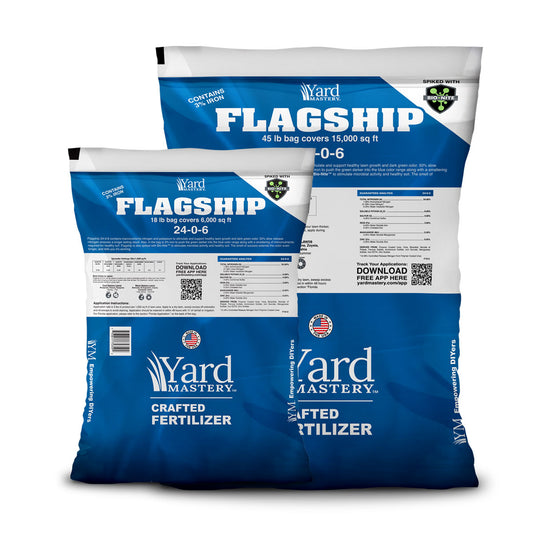
Think of it like your own diet. You probably take a multivitamin — that's your synthetic. You also eat real food — that's your natural nutrition. Some days you lean on one more than the other, but the long-term result is better when you have both in rotation. That's how I look at 24-0-6 Flagship vs. Derby Green: same family, different jobs, both belong in a good program.
And for what it's worth, Flagship has 10% natural ingredients in it too — we call that Bio-Nite, and it gets broken down by soil microbes the exact same way the natural elements in Derby Green do. There's just less of it. Flagship leans synthetic with a touch of natural; Derby Green leans natural with a touch of synthetic. Different balances.
A Closer Look at 20-0-2 Derby Green
If you've never used a natural-based fertilizer before, 20-0-2 Derby Green is the easiest place to start. Quick rundown:
- Base: soybean meal, wheat flour, feather meal — no filler.
- Quick nitrogen: a small amount of ammonium sulfate for visible response.
- Slow nitrogen: sulfur-coated urea for 45+ days of steady feeding.
- Potassium: sulfate of potash — a natural source.
- Bio-stimulant: sea kelp, a microbial food source.
- Result: visible greenup in roughly 10–14 days, with ongoing color and a soil-building effect every time you apply it.
When to Use Natural Lawn Fertilizer
Here's how I'd slot a natural fert into a real program:
Use natural lawn fertilizer when…
- Your soil is tired — sandy, low organic matter, or heavy clay that won't hold nutrients.
- You've been on synthetic-only for years and want to start building real topsoil under your turf.
- The weather is hot and you want lower burn risk.
- You want a long, steady feed instead of a sharp spike of color.
- You're trying to set your lawn up for the next season, not just push growth this week.
Lean on a faster fert (or a hybrid) when…
- Your lawn is coming out of winter dormancy and you want a visible response fast.
- You're feeding warm-season turf in peak season and want to push some growth.
- You just need a "wake-it-up" application a few days before a deadline (party, holiday, photos).
For summer stress, the natural-side counterpart to 7-0-20 Stress Blend is 5-0-15 Life Support. Same concept — potash-forward, low-nitrogen, designed to keep your lawn alive and holding color when the heat is really on — but built on a natural base with humic acid, sea kelp, and protein.
Why Natural Lawn Fertilizer Can Actually Be Cheaper
This part surprises people, because organic anything — produce, skincare, you name it — usually costs more than the conventional version. Lawn fertilizer can be the exception.
Here's why. Synthetic lawn fertilizer is built on urea, and urea is a globally traded commodity. Shipping disruptions, fuel costs, and supply pressure can push urea prices up significantly. Natural fertilizer base materials — soybean meal, feather meal, wheat flour — tend to be far less exposed to those swings. The hybrid Natural Nutrient line still has some synthetic in it, so it isn't fully immune, but because the bulk of the bag is naturally derived, the price impact is much smaller.
The result: a bag of 20-0-2 Derby Green can land at a comparable or lower price than its synthetic counterpart while doing more for your soil. That's not the usual organic story.
Frequently Asked Questions
What is the best natural lawn fertilizer?
The best natural lawn fertilizer is one that uses real organic ingredients (like soybean meal, feather meal, and wheat flour) as its base, includes a natural potassium source like sulfate of potash, and is safe to apply any time the lawn is actively growing. 20-0-2 Derby Green is a hybrid natural lawn fertilizer that fits all three — with a small amount of sulfur-coated urea added so you get a visible response within about two weeks instead of waiting a month.
How long does natural lawn fertilizer take to work?
A pure organic fertilizer typically takes 10–14 days to show visible greenup, because soil microbes have to mineralize the nitrogen before your grass can use it. A hybrid natural fertilizer like Derby Green — with a small amount of premium synthetic nitrogen on top — will start showing color sooner, then continue feeding steadily for 45+ days.
Is natural lawn fertilizer better than synthetic?
Neither is universally better — they do different jobs. Synthetic fertilizers feed the plant faster. Natural fertilizers feed the plant AND build your soil by adding organic matter and stable humus. A good program uses both: a natural-based product like Derby Green to build the soil long-term, and a synthetic-leaning product like Flagship when you need a faster visual response.
Will natural lawn fertilizer burn my grass?
The risk of burning your lawn with a natural fertilizer is very low. Because the nitrogen has to be released by soil microbes, it doesn't hit the grass in a sudden plant-available spike the way raw urea can. Stay at label rates, water in within 48 hours, and you should not see burn.
Can I use natural lawn fertilizer in summer?
Yes. Natural fertilizers are actually a strong fit for summer because they have a lower burn risk and provide steady, slow-release feeding through heat. For peak-summer stress on cool-season lawns specifically, a potash-forward natural option like 5-0-15 Life Support is built for that scenario.
Is Derby Green an organic fertilizer?
Derby Green is a hybrid: its base is natural and organically derived (soybean meal, feather meal, wheat flour, sulfate of potash, sea kelp), with a small percentage of premium synthetic nitrogen (ammonium sulfate and sulfur-coated urea) added on top to speed up the visual response. It is not certified organic, but the majority of the bag is naturally sourced and it functions as both a fertilizer and a soil amendment.
I'll see YOU in the lawn.
— AL