
Is Liquid Fertilizer Cheaper Than Granular? The Real Math for Big Lawns
Is Liquid Fertilizer Cheaper Than Granular? The Real Math for Big Lawns
Short answer: No. Liquid fertilizer is rarely cheaper than granular when you compare what actually matters — pounds of nitrogen delivered per dollar. A liquid 26-0-0 applied at the labeled rate puts down roughly ⅓ lb of nitrogen per 1,000 sq ft. A granular 24-0-6 at its labeled rate puts down ¾ lb per 1,000 sq ft. To match the granular's nitrogen output with liquid, you need nearly double the product and double the cost. The numbers tell the story.
Why Big Lawn Owners Get This Wrong
Every week, messages come in that look something like this:
"I have a really big lawn and want to use liquid fertilizer — which one should I buy? Someone told me liquid is cheaper."
That belief comes from a completely understandable place: people compare a single gallon of liquid against a single bag of granular and draw a conclusion from sticker price alone. Let's say you're looking at a 1-gallon jug of 26-0-0 liquid concentrate at $39.99 and a 45 lb bag of 24-0-6 granular at $69.99. At that surface glance, liquid wins. But that comparison is like sizing up an electric golf cart against a diesel pickup truck — they don't carry the same load.
To make an accurate comparison, you need three data points: the application rate, the nitrogen concentration (analysis), and the actual area each product covers. Without all three, you're shopping blind.
Nitrogen Drives the Bus
For big lawns — let's define that as 1 acre (43,500 sq ft) or more — the single most important investment you can make is nitrogen. Especially if you're working with a tighter budget, nitrogen is the element that delivers the visible green-up and growth response you're after.
Potassium, phosphorus, micronutrients — those all have their place. But if you have limited dollars and a lot of turf, get the nitrogen right first. Everything else is secondary.
That framing matters because it shapes how we evaluate these products. We're not comparing jug size to bag size. We're comparing dollars per pound of nitrogen delivered to the lawn.
Understanding Fertilizer Analysis (The Three Numbers)
Every fertilizer bag or jug has three numbers on the label — for example, 26-0-0 or 24-0-6. These are called the analysis, and they represent the percentage by weight of:
- Nitrogen (N) — the first number; drives green color and growth
- Phosphorus (P) — the second number; root development
- Potassium (K) — the third number; stress tolerance and disease resistance
A 26-0-0 fertilizer is 26% nitrogen by weight. The remaining 74% is carrier — in a liquid, that carrier is mostly water. In a granular, it's inert filler (and in products like Flagship 24-0-6, some of that "filler" is actually Bio-Nite, a carbon-adding natural organic material).
The analysis number alone tells you nothing about value until you layer in the application rate. That's where most people stop — and that's exactly where the myth lives.
Liquid Fertilizer Cost for 1 Acre: Greene Charge 26-0-0
Greene Charge is a high-nitrogen liquid concentrate with a 26-0-0 analysis. The label calls for 16 oz of concentrate per 1,000 sq ft, diluted into at least 2 gallons of water per 1,000 sq ft.
For a 1-acre lawn (43,500 sq ft), here's the math:
| Metric | Calculation | Result |
|---|---|---|
| Lawn size in 1,000 sq ft units | 43,500 ÷ 1,000 | 43.5 units |
| Oz of concentrate needed | 43.5 × 16 oz | 696 oz |
| Gallons needed | 696 ÷ 128 | ~5.4 gallons (use 5) |
| Cost (5-gallon case) | 2 jugs × 2.5 gal | $136.00 |
One application of Greene Charge on a 1-acre lawn costs approximately $136. (Buying by the case rather than single gallons saves money here — single gallons at $39.99 each would run $199.50 for five.)
Granular Fertilizer Cost for 1 Acre: Flagship 24-0-6
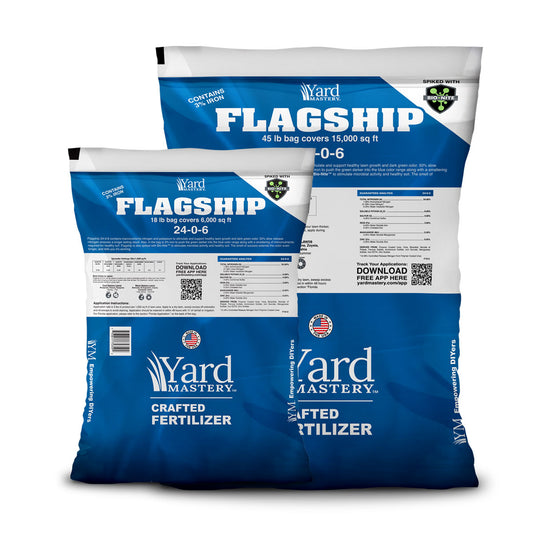
Flagship 24-0-6 is a premium granular with 24% nitrogen, 6% potassium, 3% iron, and Bio-Nite carbon. The labeled application rate is 3 lbs per 1,000 sq ft. Each 45 lb bag covers 15,000 sq ft.
| Metric | Calculation | Result |
|---|---|---|
| Bags needed | 43,500 ÷ 15,000 | ~2.9 bags (use 3) |
| Cost per bag | — | $69.99 |
| Total cost | 3 × $69.99 | $210.00 |
At first glance, $210 vs. $136 seems to confirm the myth: liquid appears cheaper. But we're still missing the most important number — how much nitrogen actually hits the ground with each product.
Pounds on the Ground: The Only Fair Comparison
"Pounds on the ground" is the term for how many actual pounds of nitrogen land on each 1,000 sq ft of lawn when you follow the labeled application rate. This single number makes an honest comparison possible.
Granular Flagship: Pounds on the Ground
Flagship is 24% nitrogen. At 3 lbs/1,000 sq ft application rate:
3 lbs × 0.24 = 0.72 lbs → rounded to ¾ lb of nitrogen per 1,000 sq ft
This aligns with university turfgrass extension recommendations from both the University of Florida (warm-season) and Purdue University (cool-season) — both of which suggest approximately ¾ lb of nitrogen per application as a healthy, non-burning rate.
Liquid Greene Charge: Pounds on the Ground
Liquids require a conversion from volume to weight before you can calculate nitrogen. Here's the step-by-step:
- Find weight per gallon: Greene Charge weighs 10.7 lbs per gallon.
- Convert to weight per ounce: 10.7 ÷ 128 = 0.084 lbs per oz
- Apply the labeled rate: 16 oz × 0.084 = 1.34 lbs of product per 1,000 sq ft
- Apply the nitrogen percentage: 1.34 × 0.26 = 0.34 lbs of nitrogen per 1,000 sq ft
That rounds to approximately ⅓ lb of nitrogen per 1,000 sq ft — less than half of what Flagship delivers per application.
| Product | Analysis | App Rate | N lbs/1,000 sq ft |
|---|---|---|---|
| Greene Charge (liquid) | 26-0-0 | 16 oz/1,000 sq ft | ~⅓ lb |
| Flagship (granular) | 24-0-6 | 3 lbs/1,000 sq ft | ~¾ lb |
Greene Charge at the labeled rate delivers 56% less nitrogen per application than Flagship.
The Real Cost Comparison: Nitrogen-Normalized
To make the comparison fair, you have to ask: what does it cost to get ¾ lb of nitrogen per 1,000 sq ft from each product?
To match Flagship's ¾ lb of nitrogen using Greene Charge, the math works out to approximately 33 oz of liquid per 1,000 sq ft instead of the labeled 16 oz.
| Product | To deliver ¾ lb N/1,000 sq ft | Product needed for 1 acre | Total cost |
|---|---|---|---|
| Greene Charge (liquid) | ~33 oz/1,000 sq ft | ~10 gallons | ~$272 |
| Flagship (granular) | 3 lbs/1,000 sq ft (label rate) | 3 bags (45 lb) | $210 |
Granular Flagship is $62 cheaper per application when nitrogen output is equal — and it includes potassium and Bio-Nite carbon that liquid Greene Charge doesn't provide.
The myth is officially busted.
Best Value for Big Lawns: Slow-Release Granular
There is one more option that beats both of the above for large-lawn, budget-conscious applications: a coated, slow-release granular fertilizer.
Pre-Ban 40-0-0 is a urea-nitrogen granular with a slow-release polymer coating. At 40% nitrogen and a 5 lbs/1,000 sq ft application rate, a single application delivers 2 lbs of nitrogen per 1,000 sq ft — trickled out at approximately ½ lb per month for 4 months.
| Product | N lbs/1,000 sq ft per app | Release type | Applications/season (big lawn) |
|---|---|---|---|
| Greene Charge | ⅓ lb | Immediately available | Multiple |
| Flagship | ¾ lb | Granular (days to uptake) | 2–4 |
| Pre-Ban | 2 lbs (over 4 months) | Coated slow-release | 1–2 |
Note for Florida homeowners: Pre-Ban was originally designed for Florida's summer nitrogen blackout period (June 1–September 30). Learn how to stay compliant →
For a 1-acre lawn, Pre-Ban requires approximately 5 bags at $89.99 each — a total of $449.95 for one application. That sounds steep at first, but consider: that single application delivers more nitrogen than six applications of Greene Charge at the labeled rate, lasts an entire growing season, eliminates multiple passes across a large property, and carries zero burn risk thanks to the coating.
One application going into the growing season, one more heading into fall, and a large lawn is well-fed for the year. For a lawn that isn't irrigated and may only see two nutrient inputs annually, this is hard to beat on a cost-per-result basis.
When Liquid Fertilizer Does Make Sense
Liquid fertilizer is not the wrong choice — it's just not the cheaper choice for big lawns when nitrogen output is the goal. There are real advantages to liquid that are worth noting:
- Speed of uptake: Certain liquid formulations (including Greene Charge) can absorb directly through the grass blades, delivering visual green-up within hours rather than days.
- Precision mixing: Liquids can be tank-mixed with other products — weed controls, fungicides, micronutrients — in a single pass.
- Small lawns: The cost-per-nitrogen-pound gap narrows considerably on lawns under 5,000 sq ft, where a single gallon or two covers the whole property.
- Hybrid programs: Many homeowners use granular as the backbone of their program and liquid as a supplemental push for fast green-up during peak growing season.
The Yard Mastery approach is never dogmatic. Use the tool that fits the job. For a big lawn on a tight budget, the job calls for granular.
Calculate It for Your Lawn
If you want to run this math for your specific lawn size without doing it by hand, the Yard Mastery App handles it automatically. Once you measure your lawn inside the app, it calculates:
- Exact gallons or bags needed per application
- Pounds of nitrogen going down per 1,000 sq ft
- Optimal product size combinations to minimize cost
- A full seasonal program based on soil temperatures in your zip code
It's a free download. Choose the DLUX program, pick liquid, granular, or hybrid, and your program populates in under five minutes.
Frequently Asked Questions
Is liquid fertilizer cheaper than granular?
No — not when you compare cost per pound of nitrogen delivered to the lawn. Liquid fertilizers applied at the labeled rate typically deliver significantly less nitrogen per 1,000 sq ft than granular at an equivalent price point. The sticker price comparison (one gallon vs. one bag) ignores application rates and nitrogen concentration entirely.
How do I calculate pounds of nitrogen on the ground from a liquid fertilizer?
Check the label for weight per gallon, divide by 128 to get weight per ounce, multiply by your application rate in oz/1,000 sq ft, then multiply that number by the nitrogen percentage (the first number in the analysis). The result is lbs of nitrogen per 1,000 sq ft.
How many gallons of liquid fertilizer do I need for 1 acre?
For a 26-0-0 liquid applied at 16 oz per 1,000 sq ft, a 1-acre lawn requires approximately 696 oz of concentrate — about 5.4 gallons. Check your specific product's label for its application rate, as it varies by product.
What is the cheapest fertilizer for a big lawn on a budget?
Granular is almost always cheaper per pound of nitrogen than liquid for large lawns. For the best value per season — fewest applications, most nitrogen, lowest cost-per-result — a slow-release coated granular with high nitrogen concentration (40%+) is the strongest option. See also: How to Apply Granular Fertilizer.
What does "pounds on the ground" mean in lawn care?
"Pounds on the ground" is the actual pounds of nitrogen deposited per 1,000 sq ft when a fertilizer is applied at the labeled rate. It's the only meaningful metric for comparing fertilizer cost and efficacy across different product formats.
Is slow-release granular fertilizer worth it for large lawns?
Yes. For large properties where you're making only one or two applications per season, slow-release granular delivers more total nitrogen per application and distributes it over months — reducing labor, eliminating burn risk, and lowering total-season cost compared to multiple liquid applications.